






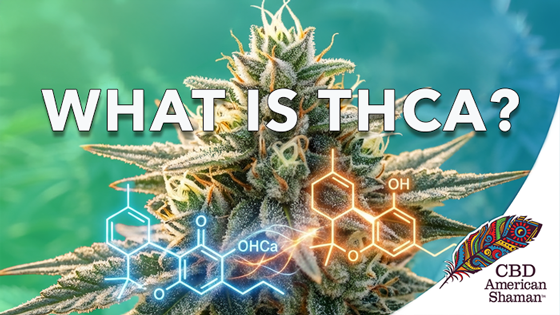
THCa is a naturally occurring cannabinoid found in raw cannabis and hemp plants. THCa exists in acidic form before heat exposure, which chemically characterizes THCa flower in its unheated state. Raw flowers contain structurally stable THCa that remains stable until the temperature initiates molecular conversion. THCa hemp flower refers to hemp-derived cannabis flower that contains tetrahydrocannabinolic acid instead of delta-9 THC, which distinguishes raw flower from psychoactive cannabis products. THCa effects and chemical behavior differ from THC, which is central to the THCa flower explained through its thermal transformation process. Raw THCa does not cause intoxication due to limited CB1 receptor activation. THCa flower behavior depends entirely on the preparation method because decarboxylation activates the psychoactive properties of THC, not the original THCa content.
What is THCa Hemp Flower?
THCa hemp flower is a type of hemp flower bred to contain elevated concentrations of tetrahydrocannabinolic acid while maintaining federally compliant delta-9 THC levels below 0.3 percent on a dry weight basis. Hemp flower THCa originates from Cannabis sativa plants cultivated through selective breeding practices that prioritize acidic cannabinoid production rather than psychoactive delta-9 THC formation. Hemp THCa flower remains non-intoxicating in raw form under current chemical classification standards because tetrahydrocannabinolic acid does not exhibit intoxicating activity without heat-driven conversion through decarboxylation. THCa hemp flower receives regulatory classification as hemp under United States federal law when laboratory testing confirms delta-9 THC concentration within the legal threshold at the time of analysis. THCa hemp flower enters interstate commerce under hemp regulations rather than marijuana controls due to the chemical distinction between acidic cannabinoids and delta-9 THC. Laboratory verification represents a mandatory step for confirming THCa hemp flower compliance and chemical composition. Consumers must review third-party certificates of analysis that report delta nine THC percentage, THCa concentration, total THC calculation, and testing date. Certificates of analysis provide objective documentation that THCa hemp flower meets legal standards at distribution while recording cannabinoid content and regulatory status.
Where to Buy THCa Flower Online? Buy THCa Flower Online through licensed hemp retailers that publish third-party laboratory documentation and operate under federal hemp distribution standards. Reputable online sellers display certificates of analysis that confirm delta-9THC compliance, provide cannabinoid composition data, list contaminant results, and offer batch-specific traceability for THCa Flower Online purchases. Purchase decisions are supported by transparent testing practices backed by up-to-date analysis and documentation tied to individual product batches. Verification requires review of certificates of analysis that report delta-9 THC below the federal threshold at the time of testing and correspond to the exact product batch offered through THCa Flower Online channels.
What does THCa Infused Mean?
THCa infused means a hemp product that contains additional tetrahydrocannabinolic acid concentrate applied directly onto hemp flower to increase total THCa content. THCa infused products originate from a base hemp flower that meets federal delta-9 THC limits, followed by application of a concentrated THCa extract through coating, spraying, or rolling processes documented in production records. THCa infused classification reflects a post-harvest infusion process rather than natural cannabinoid expression from cultivation alone. THCa infused products differ from non-infused hemp flower through increased THCa concentration that results from the added extract rather than plant genetics. THCa infused labeling signals products processed with extract, which requires attention to infusion techniques, concentration levels, and laboratory documentation associated with THCa infused flower. Consumers must review infusion methods and cannabinoid data listed on certificates of analysis to confirm delta-9 THC compliance and consistency across product batches.
How is THCa Flower Made?
THCa flower is made by selective cultivation of hemp genetics bred to express increased tetrahydrocannabinolic acid levels while maintaining federally compliant delta-9 THC concentration. THCa flower production begins in controlled agricultural environments where growers manage light cycles, nutrient inputs, and harvest timing to preserve acidic cannabinoids in raw form. THCa flower harvesting occurs at peak resin development to preserve THCa content before any heat-related conversion. THCa flower processing avoids exposure to heat, prolonged light, and mechanical stress to support cannabinoid integrity during storage. THCa flower curing and storage rely on low temperature drying, controlled humidity, and sealed packaging for chemical stability. THCa flower quality depends on careful post-harvest handling verified through laboratory analysis that confirms THCa concentration and legal delta-9 THC limits.
What does THCa Hemp Flower Look Like?
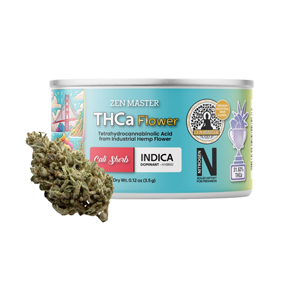
THCa hemp flower looks visually similar to traditional cannabis flower with dense buds, visible trichome coverage, and vibrant green coloration. THCa hemp flower presents tightly formed colas coated in resin glands that indicate visible trichome content rather than active compound presence. THCa hemp flower structure, aroma profile, and surface frostiness resemble marijuana flower despite its regulatory classification as hemp. THCa hemp flower appearance does not indicate cannabinoid content or legal classification because visual traits do not reflect delta-9 THC concentration. THCa hemp flower verification relies on laboratory reports that document cannabinoid levels, testing dates, and compliance thresholds rather than surface characteristics. Laboratory analysis represents the most consistent method to identify THCa hemp flower composition and verify regulatory status.
How is THCA Flower Tested?
THCa flower is tested by an independent laboratory analysis that measures cannabinoid content, verifies delta-9 THC concentration, and supports federal hemp classification review. THCa flower testing begins with batch sampling submitted to accredited laboratories that use chromatography methods to quantify THCa, delta-9 THC, and total THC values. THCa flower results determine legal classification under federal hemp standards when delta-9 THC remains below the statutory threshold at the time of testing. THCa flower laboratory reports document cannabinoid percentages, testing dates, batch identifiers, and analytical methods used during evaluation through THCa Lab Test Results and Reports. THCa flower testing protocols include contaminant screening for pesticides, heavy metals, residual solvents, and microbial activity to document product composition and processing record accuracy. Certificates of analysis serve as documented references for verifying THCa flower classification, composition, and test-documented composition details rather than relying on visual appearance or marketing claims.
Is THCa Flower Natural?
Yes, THCa flower is natural because tetrahydrocannabinolic acid occurs naturally in cannabis plants during normal growth and resin development. THCa flower forms when cannabis plants synthesize cannabinoids in acidic form before heat exposure or aging, which triggers chemical conversion. THCa flower presence reflects plant genetics, cultivation conditions, and harvest timing rather than artificial chemical alteration. THCa flower differs from synthetic cannabinoids because THCa originates from biological processes inside the cannabis plant. THCa flower evaluation requires distinction between naturally expressed cannabinoids and laboratory-created compounds designed to replicate cannabinoid behavior. Verification is supported by reviewing botanical sourcing information and lab documentation that confirms plant-based THCa origin.
What does THCa Do?
THCa interacts with biological systems through non-intoxicating molecular activity that differs from delta-9 THC because tetrahydrocannabinolic acid does not bind to cannabinoid receptors in the same way. THCa exists in raw cannabis and remains chemically stable until heat exposure alters its molecular structure through decarboxylation. The behavior of THCa is a reflection of chemical presence rather than what is associated with THC. THCa behavior changes based on preparation method and thermal exposure because raw intake preserves its acidic form, while heat converts THCa into THC. THCa profiles shift when smoking or vaporization introduces thermal decarboxylation that results in cannabinoid conversion. Understanding
THCa requires recognition of its chemical stability, preparation method, and verified cannabinoid transformation through lab data rather than assumptions based on THC.
What are the Effects of THCa Flower?
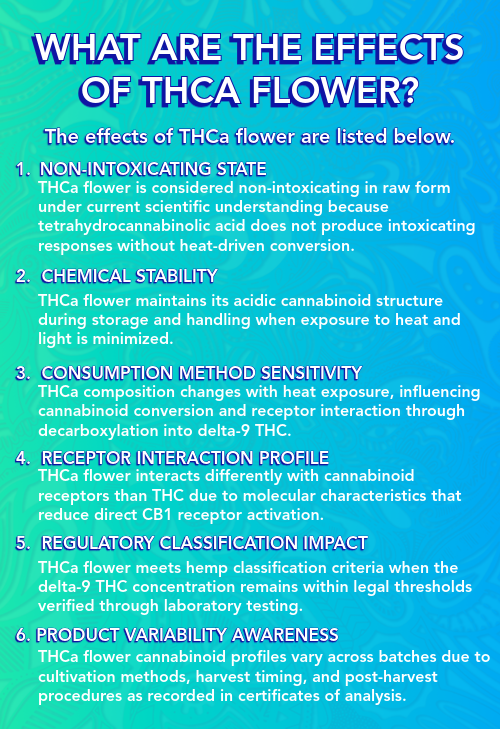
The effects of THCa Flower are listed below.
- Non-Intoxicating State: THCa flower is considered non-intoxicating in raw form under current scientific understanding because tetrahydrocannabinolic acid does not produce intoxicating responses without heat-driven conversion.
- Chemical Stability: THCa flower maintains its acidic cannabinoid structure during storage and handling when exposure to heat and light is minimized.
- Consumption Method Sensitivity: THCa composition changes with heat exposure, influencing cannabinoid conversion and receptor interaction through decarboxylation into delta-9 THC.
- Receptor Interaction Profile: THCa flower interacts differently with cannabinoid receptors than THC due to molecular characteristics that reduce direct CB1 receptor activation.
- Regulatory Classification Impact: THCa flower meets hemp classification criteria when the delta-9 THC concentration remains within legal thresholds verified through laboratory testing.
- Product Variability Awareness: THCa flower cannabinoid profiles vary across batches due to cultivation methods, harvest timing, and post-harvest procedures as recorded in certificates of analysis.
What are the Side Effects of THCa Flower?
The side effects of THCa flower are listed below.
- Non-intoxicating in Raw Form: THCa flower is considered non-intoxicating in raw form under current scientific understanding because tetrahydrocannabinolic acid does not activate CB1 receptors associated with intoxication without heat-driven conversion.
- THC Conversion Risk: THCa flower exposure to heat during smoking or vaporization converts THCa into delta-nine THC, which results in cannabinoid transformation following thermal conversion rather than effects from THCa itself.
- Preparation Sensitivity: THCa flower behavior may vary with preparation method, metabolism, amount used, and cannabinoid concentration documented through laboratory analysis.
- Smoke Exposure Consideration: Smoke particulates may introduce respiratory irritation during combustion, independent of cannabinoid chemistry.
- Contaminant Screening: THCa flower without verified laboratory screening may contain processing byproducts, chemical residues, heavy metals, or microbial presence.
- Classification Shift Risk: THCa flower tested inaccurately or stored improperly may exceed delta nine THC limits after conversion, which affects legal classification rather than original cannabinoid composition.
- Batch-Level Variation: Cannabinoid profiles vary across harvests due to ultivation practices, harvest timing, and post-harvest conditions associated with THCa Side Effects, as recorded in certificates of analysis.
How do the Effects of THCa Flower Change when Heated?
The effects of THCa Flower change when heated by the conversion of tetrahydrocannabinolic acid into delta-9 THC through a chemical process known as decarboxylation. THCa flower is considered non-intoxicating in raw form based on current understanding of cannabinoid receptor activity because tetrahydrocannabinolic acid does not activate cannabinoid receptors linked to intoxication until heat alters the compound’s structure. Heat exposure drives molecular transformation that enables structural changes associated with THC activity. THCa flower heating occurs during smoking, vaporization, or other high-temperature preparation methods that induce chemical change rather than preserve acidic cannabinoid form. THCa flower’s chemical behavior after heating aligns with THC-dominant cannabinoid profiles, reflecting a shift in cannabinoid activation and interaction potential. Recognizing the change highlights that THCa acts as a non-decarboxylated compound or a converted cannabinoid with THC activity, depending on preparation method and temperature exposure.
Does THCa Flower get you hyper?
No, THCa flower is not associated with hyperactivity in raw form under current research because tetrahydrocannabinolic acid does not interact with cannabinoid receptors responsible for mental stimulation. THCa flower is considered non-intoxicating before heat exposure due to its inability to activate CB1 pathways linked to mood or energy shifts. THCa flower does not exhibit stimulant-like characteristics in raw form. THCa flower behavior changes when exposed to heat, which converts tetrahydrocannabinolic acid into delta-9 THC through decarboxylation. Delta-9 THC has been linked to cannabinoid activity that may influence alertness. Changes in stimulation are related to converted THC, not THCa in raw form.
Is THCa Flower harmful?
No, THCa flower is not harmful in raw form based on available research when products are properly cultivated, lab-verified, and free from contaminants according to current analytical documentation. THCa flower is considered non-intoxicating until heat exposure initiates decarboxylation. Safety depends on product purity, accurate labeling, and the absence of contaminants. Each factor must be verified through current certificates of analysis. The risk profile of THCa flower shifts once it is exposed to heat, which converts THCa into delta-9 THC. The chemical transition produces the behavioral properties associated with THC. Inhalation of THCa flower via combustion may contribute to typical combustion-related exposure risks unrelated to cannabinoid chemistry. Assessing THCa flower for safe use requires reviewing preparation method, batch-specific lab testing, and regulatory compliance. The evaluation must not rely on assumptions based solely on its name or classification.
What are the differences between THC and THCa?
The differences between THC and THCa center on chemical structure, behavioral activity, and biological interaction. THC represents the decarboxylated form of tetrahydrocannabinol that is associated with CB1 receptor activation that influences perception and cognition, while THCa is the acidic precursor synthesized naturally in raw cannabis plants. THCa is considered non-intoxicating due to its molecular structure that reduces CB1 receptor affinity until heat exposure modifies the compound through decarboxylation. THC formation occurs when THCa undergoes decarboxylation during smoking, vaporization, or other high-temperature processes. THCa presence reflects cultivation and harvest timing, while THC presence reflects post-harvest thermal conversion, which defines the basis for the comparison described as THC vs THCA.
How does THCa Flower Compare to CBD Flower?
THCa flower differs from CBD flower in primary cannabinoid content, chemical behavior, and observed characteristics. THCa flower contains tetrahydrocannabinolic acid that remains non-intoxicating until heat converts it through decarboxylation, while CBD flower contains cannabidiol that stays non-intoxicating even after heat exposure during controlled processing stages. THCa flower production focuses on preserving acidic cannabinoids through cultivation and post-harvest handling, while CBD flower cultivation emphasizes cannabidiol expression with minimal THC development. THCa flower comparison to CBD flower involves regulatory classification and usage context. THCa flower classification depends on delta-9 THC concentration at the time of testing, while CBD flower classification remains more stable due to consistent cannabinoid chemistry. THCa flower chemical behavior changes based on heating and preparation method, while CBD flower chemistry remains stable under similar conditions, which demonstrates a distinct chemical behavior difference between THCa flower and CBD flower.
What are the Benefits of THCa Hemp Flower?
The benefits of THCa hemp flower are listed below.
- Natural Cannabinoid Presence: THCa hemp flower contains tetrahydrocannabinolic acid produced naturally by the cannabis plant during normal growth and resin development.
- Non-Intoxicating Raw State: THCa hemp flower is considered non-intoxicating in raw form under current scientific understanding due to minimal CB1 receptor activity before heat exposure.
- Regulatory Hemp Classification: THCa hemp flower qualifies as hemp under federal law when delta nine THC concentration remains below statutory limits at the time of certified laboratory testing.
- Chemical Stability Before Heating: THCa hemp flower preserves acidic cannabinoid structure through controlled cultivation, harvesting, curing, and storage practices designed to avoid decarboxylation.
- Preparation Method Flexibility: Chemical behavior of THCa hemp flower changes with preparation method, enabling differentiation between raw cannabinoid form and heat-altered THC outcomes.
- Laboratory Transparency: THCa hemp flower distribution depends on certificates of analysis that confirm cannabinoid composition, batch consistency, and legal compliance.
- Product Differentiation: THCa hemp flower presents a distinct cannabinoid profile compared to CBD flower and THC-dominant cannabis, which helps establish defined categories in hemp markets.
How is THCa Flower Used?
THCa flower is used by preparation methods that preserve tetrahydrocannabinolic acid in raw form or convert the compound through heat exposure. Using THCa flowers without heating maintains the acidic cannabinoid structure and limits psychoactive conversion under raw conditions. THCa flower use with heating through smoking or vaporization triggers decarboxylation that converts THCa into delta nine THC, which alters cannabinoid profile and receptor activity potential. THCa flower handling requires attention to temperature control, storage practices, and confirmed laboratory documentation aligned with the intended form of use. Selection of THCa flowers is based on preparation preference, cannabinoid concentration, and delta nine THC compliance verified through certificates of analysis rather than appearance or aroma.
How do you Use THCa Flower Safely?
Use THCa flower safely by following the four steps. First, verify that THCa flower comes from laboratory-tested products with certificates of analysis that confirm delta nine THC compliance, cannabinoid potency, and contaminant screening, since verified data establishes product safety and legality. Second, follow potency data provided through laboratory reports rather than visual assessment or aroma, because potency varies by batch and cultivation method. Third, understand that THCa flower changes behavior when exposed to heat, since decarboxylation converts tetrahydrocannabinolic acid into delta nine THC and alters effects. Fourth, control preparation temperature and storage conditions to align use with the intended outcome, because raw handling preserves non-intoxicating properties while heating produces intoxicating effects.
Who should consider THCa Flower?
Consumers seeking flexibility between non-intoxicating and heat-converted cannabinoid outcomes due to its preparation-dependent chemical properties should consider THCa flower. THCa flower is considered non-intoxicating in raw form under current research because tetrahydrocannabinolic acid does not activate CB1 receptors until exposed to heat. The preparation control results in varying cannabinoid expressions depending on use method. THCa flower is selected by experienced cannabis users, regulated hemp buyers, and researchers interested in preparation-dependent cannabinoid transformation rather than fixed chemical expression. Consumers evaluating THCa flower must evaluate preparation method and personal experience level, along with legal status, before purchase or use. THCa flower legality is based on delta nine THC concentration at the time of laboratory testing, which differs by jurisdiction. Product selection requires a thorough review of certificates of analysis, preparation intent, and compliance documentation rather than product visuals or promotional language.
Is THCa Hemp Flower Legal?
Yes, THCa hemp flower is legal under United States federal hemp standards when delta nine THC concentration remains below 0.3 percent by dry weight at the time of certified laboratory testing. THCa hemp flower qualifies as hemp rather than marijuana because tetrahydrocannabinolic acid is excluded from delta nine THC calculation under the Agriculture Improvement Act of 2018. Federal compliance relies on verified laboratory reports that confirm cannabinoid composition and distribution-stage alignment. THCa hemp flower regulatory treatment varies at the state level due to enforcement standards and policy interpretation. The continuation of compliance relies on monitoring certificates of analysis, storage conditions, and postharvest handling because chemical conversion can affect delta-9 THC levels. Possession and sale remain compliant when supported by verified documentation demonstrating adherence to federal and state hemp regulations.
Is THCa federally legal? Yes, THCa is federally legal under United States law when derived from hemp that contains no more than 0.3 percent delta-9 THC on a dry weight basis at the time of laboratory testing. THCa qualifies as a lawful hemp constituent under the Agriculture Improvement Act of 2018 because tetrahydrocannabinolic acid is not counted toward delta-9 THC limits used for federal hemp classification. Federal legality for THCa depends on laboratory documentation that confirms delta-9 THC compliance before product distribution. THCa’s federal status does not override state-level restrictions, since individual states apply separate enforcement standards and legal interpretations that influence possession and sale. The state-level variation plays a key role in determining THCa legality based on jurisdictional standards and regulatory enforcement.
Is THCa Hemp Flower Legal in California?
No, THCa hemp flower does not qualify for legal retail sale in California under current state hemp regulations. California law defines hemp compliance based on total THC content, not just delta-9 THC, which means tetrahydrocannabinolic acid is included in the total THC calculation. THCa hemp flower exceeds the total THC limit defined by the California Department of Public Health, even when delta-9 THC is below 0.3 percent. California hemp enforcement includes THCa in total THC because of its predictable conversion through heat or degradation. THCa hemp flower is excluded from compliant hemp classification under state enforcement policies and is not permitted for manufacture, distribution, or retail sale under standard hemp commerce regulations. Legal access is limited to licensed cannabis supply chains, meaning use, possession, and sale of THCa hemp flower in California requires review of state regulations, which operate independently of federal hemp law.
Does THCa Flower Show Up on a Drug Test?
Yes, THCa flower shows up on a drug test because standard screening methods detect THC metabolites, not the original cannabinoid form. THCa converts into delta-9 THC through heat exposure during smoking or vaporization, and metabolic processes further break down THC into THC-COOH, the primary compound targeted in urine, blood, and saliva tests. THCa flower use without heating may result in detectable THC metabolites due to partial conversion from digestion, improper storage, or incidental heat exposure. Drug testing protocols do not distinguish between THC sources, and metabolites from THCa flower may produce THC metabolite levels consistent with those found in standard cannabis use. THCa flower use may result in drug test outcomes similar to cannabis products containing THC, regardless of hemp classification.