






For Immediate Release · July 30, 2026 · Kansas City, Mo.
Film documents the manufacturing process as the federal comment window on the proposed 0.050 percent threshold closes, five days before a scheduling order can issue.
A documentary by journalist Hamilton Morris on the industrial synthesis of 7-hydroxymitragynine has passed 243,000 views in its first day, with more than 9,500 likes on Morris’s 291,000-subscriber channel. Morris describes the film as the first documentation of the process.
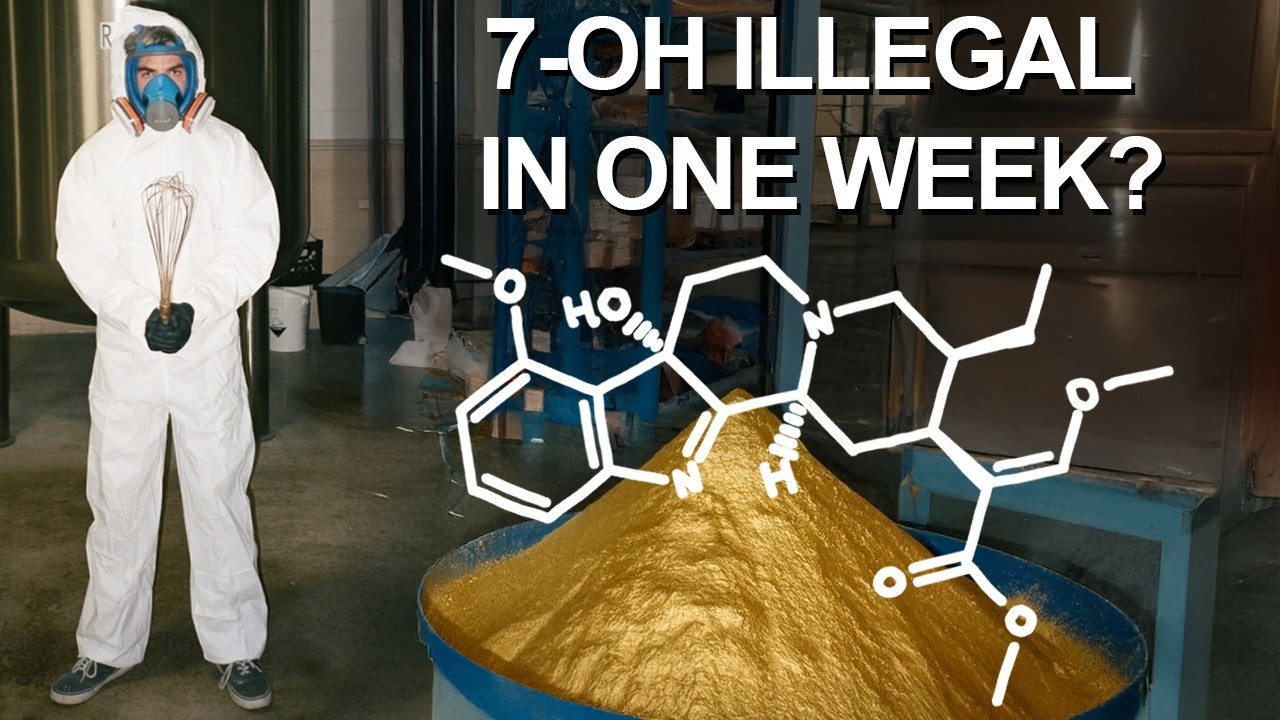
The Chemistry of 7-OH runs 18 minutes and was shot inside CBD American Shaman’s Kansas City production facility. It arrives as the only open federal comment channel on the compound closes.
The U.S. Department of Health and Human Services’ Request for Information, docket HHS-OASH-2026-0232, closes Friday, July 31 at 11:59 p.m. ET. A Drug Enforcement Administration order placing 7-hydroxymitragynine above a specified threshold into Schedule I cannot issue before August 5, 2026. More than 8,900 comments had been filed as of July 29.
Watch: The Chemistry of 7-OH
Hamilton Morris · 18 minutes
What the film shows
Morris was given unrestricted access to the full production process. Cameras follow the reaction from kratom leaf extract through oxidation in a 2,000-liter vessel, HPLC analysis of the conversion, solvent recovery across a bank of rotary evaporators, and liquid-liquid purification. The film also documents a countercurrent chromatography instrument that staff describe as one of only a handful in the world.
The access was not incidental. In the film, company founder Vince Sanders describes deciding to open the facility to reporters as criticism mounted:
“Come on, see what we’re doing. Nothing hidden here… I’d be happy to show you exactly how we make it.”
The documentary does not present a single point of view. It includes broadcast segments comparing 7-OH to opioids, critics who call it dangerously addictive, and users who describe their own experience. Morris states his own position directly:
“Even if you hate it, even if you think it’s terrible, even if you think no one should ever take it, prohibition is not a good solution because it will interfere with science.”
Elsewhere in the film he puts it more plainly: “It’s a health medical problem, not a criminal one.”
The threshold, and the measurement question
The HHS notice asks two narrow questions: whether data support the proposed threshold or an alternative level, and whether alternative measurement expressions exist. It states explicitly that it is not soliciting comment on any permanent scheduling decision or on the general safety or utility of kratom-derived products.
The proposed threshold is 0.050 percent 7-hydroxymitragynine on a dry weight basis for botanical material. For synthetic material, and for processed forms such as extracts, concentrates, edibles and pressed pills, it is 0.050 percent by weight/weight, weight/volume or volume/volume, or more than 1.00 milligram in the article. The DEA notice states the figure “was adapted from the definition used by the Department of Health and Human Services.” The notice does not include a dose-response analysis.
Two published datasets bear on where a workable line would fall:
- An FDA assessment cites Sharma et al. (2025), a study of 341 consumer kratom products in which 7-hydroxymitragynine content, expressed as a percentage by weight/weight or weight/volume, ranged from below the limit of quantitation to a maximum of 0.21 percent, with a mean of 0.01 percent.
- Brown et al. (Journal of AOAC International, 2026) measured 22 to 75 milligrams per gram dry weight, or 2.2 to 7.5 percent, in products misbranded as kratom.
The two figures use different denominators and are not directly interchangeable for liquid products.
CBD American Shaman has said it does not oppose regulation of the compound, and is asking the agencies to describe how the threshold figure was derived. In the film, Sanders puts the company’s position on regulation this way:
“As long as we’re allowed to exist, I don’t mind whatever the regulations are, how high that bar might be. We’ll meet them. And the people that can’t meet them, then maybe they shouldn’t be in it.”
Sanders, whose background is at vincesanders.com, also describes the operational effect of state-level restrictions in the film, including a facility closure and layoffs documented on camera.
Background
DEA issued a materially similar notice of intent covering mitragynine and 7-hydroxymitragynine in 2016 and withdrew it that October. Under 21 U.S.C. 811(h)(6), a temporary scheduling order is not subject to judicial review.
Policy organizations including the Cato Institute, the R Street Institute and the Reason Foundation have published analyses in 2026 questioning temporary Schedule I placement for 7-hydroxymitragynine.
Availability
The Chemistry of 7-OH is available at youtube.com/watch?v=p3e1aFyw6v4.
Information on the federal comment process, including the scope of the questions HHS posed, is at action.cbdamericanshaman.com.
Media contact
Liz Zarins, Second Summit PR
[email protected] · (410) 868-7602
About CBD American Shaman. CBD American Shaman is a Kansas City-based manufacturer of hemp and botanical products. 7-hydroxymitragynine is not approved by the U.S. Food and Drug Administration for any use, and no therapeutic claims are made in this release. The company’s alkaloid products are not sold in Missouri. The company manufactures products in this category and has a commercial interest in the outcome of the proceeding described above.